Imagine a lemonade stand that spends $2 on flyers and free samples for every new customer. Each customer buys one cup for $1.50 and never comes back. The stand is busy, the line is long and everyone's talking about it.
There's just one problem: every new customer makes it 50 cents poorer.
It sounds silly with lemonade. But many real businesses do exactly the same thing with ads, discounts and sales teams, and they don't notice until the money runs out. The fix starts with two numbers every founder should know by heart: CAC and LTV.
- CAC is what it costs to win one customer. LTV is the profit that customer brings over time.
- If CAC is higher than LTV, growing faster only makes your losses bigger.
- MoviePass grew to millions of subscribers while losing money on many of them, and shut down in 2019.
- A common rule of thumb is an LTV at least three times your CAC.
- You can improve the math by raising prices, keeping customers longer or lowering acquisition costs.
The Ticking Time Bomb Nobody Sees
Revenue is exciting. It's easy to celebrate a record month, a full inbox and a growing customer list. But revenue alone doesn't tell you whether your business is healthy. What matters is what happens per customer.
That's what unit economics means: the money you make or lose on a single unit, usually one customer. If each customer is profitable, growth makes you stronger. If each customer loses money, growth simply loses money faster.
Scaling a broken model doesn't fix it. It makes the hole bigger.
CAC: What It Costs to Win a Customer
Customer acquisition cost, or CAC, is everything you spend to win new customers, divided by the number of new customers you won.
Example: you spend $3,000 on ads, tools and freelancer time in a month and win 60 new customers. Your CAC is $50.
Be honest about what goes in. Ads are obvious, but so are discounts for first orders, sales commissions, marketing software and the time you or your team spend on marketing. Leaving costs out makes CAC look better than it really is.
LTV: What a Customer Is Worth Over Time
Lifetime value, or LTV, estimates how much profit a typical customer brings in during their whole relationship with you. Use profit, not revenue, because revenue ignores what it costs you to deliver.
Example: each order earns $20 in profit, customers order 4 times a year and stay about 2 years. LTV = $20 × 4 × 2 = $160.
In this example, a customer who costs $50 to win brings in $160 of profit. That's a healthy business. If the same customer cost $200 to win, every sale would quietly lose $40.
The MoviePass Lesson
In 2017, the movie subscription service MoviePass cut its price to $9.95 a month, letting members see a movie in theaters every day. People loved it. By the summer of 2018, it had nearly 3 million subscribers, according to NPR.
The catch was in the unit economics. MoviePass generally paid theaters the full ticket price for each movie a member watched. In many cities, a single ticket cost more than the entire monthly fee. The more members used the service, the more money it lost. Its chief executive estimated the company was burning about $21 million a month at one point.
MoviePass tried price changes and viewing limits, but the math never worked. The service shut down in September 2019.
The lesson isn't that big promotions are always bad. It's that growth only helps when each customer adds value instead of draining it.
The Ratio That Matters: LTV to CAC
Once you know both numbers, divide LTV by CAC. Investors and growth experts, including venture capitalist David Skok, often suggest a simple rule of thumb:
Below 1:1
You lose money on every customer. Stop scaling and fix the model first.
Around 1:1 to 2:1
You might break even, but there's little left over to pay for everything else, like rent, salaries and your own income.
3:1 or better
Often considered healthy. Each customer brings back at least three times what it cost to win them.
Another useful check is payback time: how many months it takes for a customer's profit to cover what you spent to win them. Many businesses aim for a year or less. The longer the payback, the more cash you need while you wait.
Five Ways to Fix the Math
1. Raise your prices
Even a small price increase can improve LTV a lot, because most of it goes straight to profit.
2. Keep customers longer
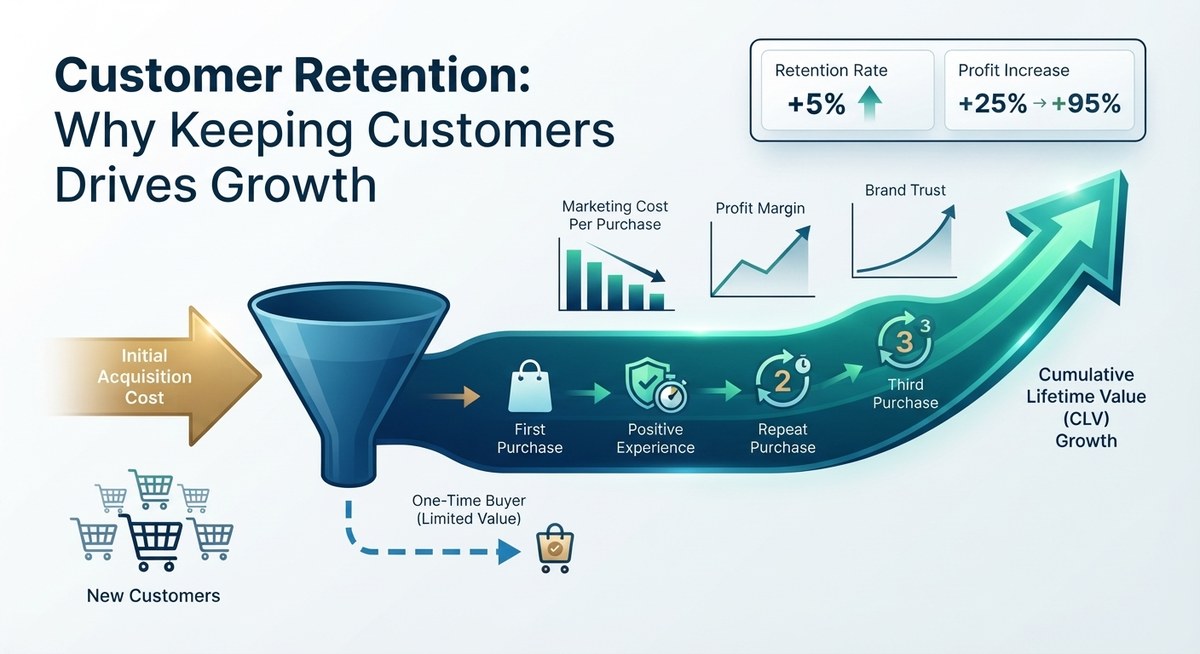
Better onboarding, follow-ups and service help customers stay. We cover this in our guide to customer retention.
3. Increase order value
Bundles, add-ons and smart cross-sells raise the profit from each purchase.
4. Lower acquisition costs
Cut ads that don't convert, lean on referrals and invest in content and SEO, which can keep bringing customers without paying per click.
5. Focus on your best customers
Some customer groups stay longer and spend more. Find them and point your marketing their way.
Conclusion: Know Your Numbers Before You Grow
Growth feels like success, but growth on broken unit economics is just a faster way to run out of money.
This week, calculate your CAC and LTV, even roughly, on a single sheet of paper. If LTV is comfortably higher, scale with confidence. If it isn't, fix the math first. Then grow.
Frequently Asked Questions
What is CAC?
Customer acquisition cost: your total sales and marketing spend divided by the number of new customers you won in the same period.
What is LTV?
Lifetime value: the total profit a typical customer brings in over the whole time they stay with your business.
What is a good LTV to CAC ratio?
A common rule of thumb is 3:1 or better, meaning each customer brings in at least three times what it cost to win them.
What happens if CAC is higher than LTV?
You lose money on every new customer, so growing faster increases losses. Fix pricing, retention or acquisition costs before scaling.
How can I lower my customer acquisition cost?
Cut ads that don't convert, encourage referrals, invest in content and SEO and focus on the customer groups that buy most often.