Imagine walking down a busy street in a new city. You are looking for a place to eat lunch. You pass two restaurants side by side.
Restaurant A is completely empty, pristine, and quiet. The waiters stand by the door looking hopeful, but the tables are bare.
Restaurant B has a line out the door. You can hear the hum of conversation, the clinking of glasses, and bursts of laughter from inside.
Which one do you choose?
Even if Restaurant A might be a hidden culinary masterpiece, human instinct almost always pulls us toward the crowd. We think: if all those people chose to eat there, it must be good. We borrow the collective judgment of strangers to reduce our own risk.
In the digital world of business, sales, and modern branding, this phenomenon has a name: social proof.
Whether you are launching a SaaS startup in Austin, selling handmade leather goods on Shopify, or running a boutique digital marketing agency, social proof is the invisible engine driving your growth. Without it, you are asking customers to take a blind leap of faith. With it, you are inviting them to join a trusted movement.
Let's dive deep into why social proof works, how to use it authentically, and the real-world stories of brands that turned simple customer words into millions in revenue.
- Social proof is the shortcut humans use to decide what's correct by copying others — it transfers trust from an unbiased peer to your brand.
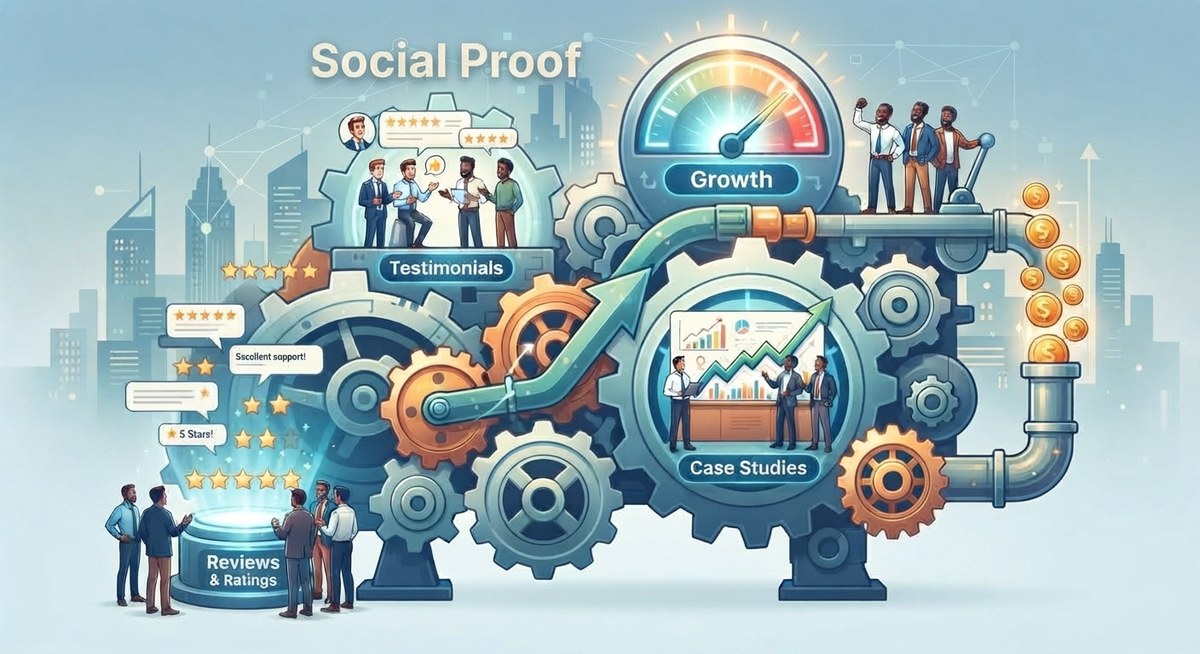
- Effective proof comes in three forms: reviews and ratings, emotional testimonials, and data-backed case studies.
- Real-time signals like Booking.com's "booked 4 times in the last 24 hours" pair social validation with healthy FOMO.
- Fake reviews, anonymous testimonials, and hiding every flaw destroy trust faster than having no proof at all.
What Is Social Proof, Really?
Coined by psychologist Robert Cialdini in his classic book Influence, social proof is the psychological shortcut humans use to determine correct behavior in a given situation by copying others.
In business, it answers the fundamental question every potential buyer asks themselves: "Has anyone else like me tried this, and did it actually work for them?"
When people look at your website or your product page, they are naturally skeptical. They know you love your own product — you built it, or you are getting paid to sell it. Your marketing copy is naturally biased. But when a complete stranger writes a glowing review or shares a transformation story, the dynamic changes instantly.
Trust is transferred from an unbiased peer to your brand.
The Three Pillars of Social Proof
To build a high-converting growth engine, you need more than just a generic "Thank you!" banner on your homepage. Effective social proof generally falls into three main buckets.
1. Reviews and Ratings: The Everyday Validation
Ratings and reviews are the digital equivalent of word-of-mouth recommendations. Think about the last time you booked an Airbnb or bought a gadget on Amazon. Did you buy the item with a 2-star rating, or did you scroll until you found the one with hundreds of 4.5-star reviews?
The human angle: people trust everyday folks. When a review mentions a specific detail — like, "The customer service team answered my email within ten minutes on a Sunday" — it feels real and unscripted.
2. Testimonials: The Emotional Connection
While reviews give quick star ratings, testimonials dive deeper into the emotional journey. A great testimonial tells a mini-story: where was the customer before? How did they feel? What happened when they used the product? Where are they now?
The human angle: good testimonials do not just talk about features; they talk about relief, joy, and solved problems. They make the reader say, "Hey, that sounds just like my current frustration!"
3. Case Studies: The Ultimate Proof of Mastery
Case studies are deep-dive success stories. They are especially powerful in B2B (business-to-business) or high-ticket sales. A case study walks the reader through a specific problem, the strategy applied, and the measurable results achieved.
The human angle: numbers tell, but stories sell. Seeing a concrete graph showing a 200% increase in revenue gives logical buyers the hard data they need to justify their purchase.
Real-World Stories: How Brands Mastered Social Proof
Let's look at how global brands and nimble startups use social proof to accelerate growth.
Story 1: The Booking Platform That Let the Numbers Speak
When Booking.com scaled globally, they realized that travelers suffer from severe choice paralysis. There are thousands of hotels in any given city. How do you choose?
Instead of just showing hotel descriptions, Booking.com injected real-time social proof directly into the user experience. When you click on a hotel, you might see small, urgent notifications pop up:
- "Booked 4 times in the last 24 hours"
- "John from London just booked a double room"
- "Only 1 room left at this price!"
Why it worked: it created a healthy sense of FOMO (fear of missing out) combined with undeniable social validation. It shifted the user's mindset from "Is this hotel okay?" to "I better grab this before someone else does."
Story 2: The Project Management Tool That Grew Through User Wins
Basecamp, a pioneer in project management software, rarely relies on flashy celebrity endorsements. Instead, they let their community of everyday project managers, freelancers, and small business owners do the talking.
On their case study and testimonial pages, they don't just feature massive enterprise giants. They feature regular folks — freelance designers, local bakery owners, remote marketing agencies. They highlight exact quotes about how chaotic life was before Basecamp ("We were drowning in endless email threads") versus how peaceful life is now ("Everything is in one place").
Why it worked: by keeping the examples relatable, any small business owner reading the page can easily picture themselves stepping out of chaos and into clarity.
Common Pitfalls: How to Ruin Good Social Proof
Social proof is powerful, but it is also fragile. If executed poorly, it can destroy trust faster than having no reviews at all. Watch out for these common traps:
- The fake review trap: consumers today have a finely tuned radar for authenticity. Overly polished, robotic five-star reviews that sound like they were written by a legal team do more harm than good. Real reviews often have minor imperfections or specific context.
- The anonymity mistake: a testimonial signed "J.S., New York" carries very little weight. Whenever possible, include a real full name, a clear profile picture, a company name, or a link to a verified social profile. Identity breeds accountability and trust.
- Hiding the friction: perfection looks fake. If a product has overwhelmingly positive reviews with a few balanced, constructive three-star notes about shipping delays that were quickly resolved by support, it actually makes the entire review profile look more authentic and trustworthy.
How to Implement Social Proof Today
If you want to weave social proof into your own brand growth strategy, start with these actionable steps:
- Automate the ask: don't wait for customers to magically remember to leave a review. Set up automated email sequences that trigger a few days after product delivery or service completion, gently asking for honest feedback.
- Highlight specificity over generosity: a review that says "Great product!" is nice, but a review that says "This saved me three hours of formatting every single week" is gold. Feature the specific benefit in bold on your landing pages.
- Scatter proof throughout the journey: don't tuck all your testimonials away on a lonely "Testimonials" page that nobody visits. Place relevant micro-testimonials right next to your "Buy Now" buttons, signup forms, and pricing tables where buying decisions are actually made.
The Bottom Line
At its core, business is not about transactions between cold corporations and faceless consumers. It is a human-to-human exchange built entirely on trust.
When you proudly display the real, unfiltered voices of people who have already taken the journey with your brand, you remove the friction of doubt. You build a bridge of confidence. And in a crowded digital marketplace, trust is the ultimate competitive advantage that turns casual browsers into lifelong brand advocates.
Frequently Asked Questions
What is social proof in marketing?
Coined by psychologist Robert Cialdini, it's the psychological shortcut people use to decide the right behavior by copying others. In business it answers the buyer's core question: has anyone like me tried this, and did it work?
What are the three main types of social proof?
Reviews and ratings for everyday validation, testimonials that tell an emotional before-and-after story, and case studies that walk through a problem, a strategy, and measurable results — especially powerful in B2B.
How did Booking.com use social proof to overcome choice paralysis?
It surfaced real-time signals like 'Booked 4 times in the last 24 hours' and 'Only 1 room left at this price,' combining social validation with healthy urgency so users moved from 'Is this hotel okay?' to 'I'd better grab this now.'
Why can social proof backfire?
Overly polished fake reviews, anonymous testimonials like 'J.S., New York,' and hiding every imperfection all read as inauthentic. A few balanced three-star reviews with resolved issues can actually make a profile look more trustworthy.
How do I get more genuine reviews and testimonials?
Automate the ask with an email sequence a few days after delivery, feature specific benefits over generic praise, and place micro-testimonials next to buy buttons, signup forms, and pricing tables where decisions actually happen.