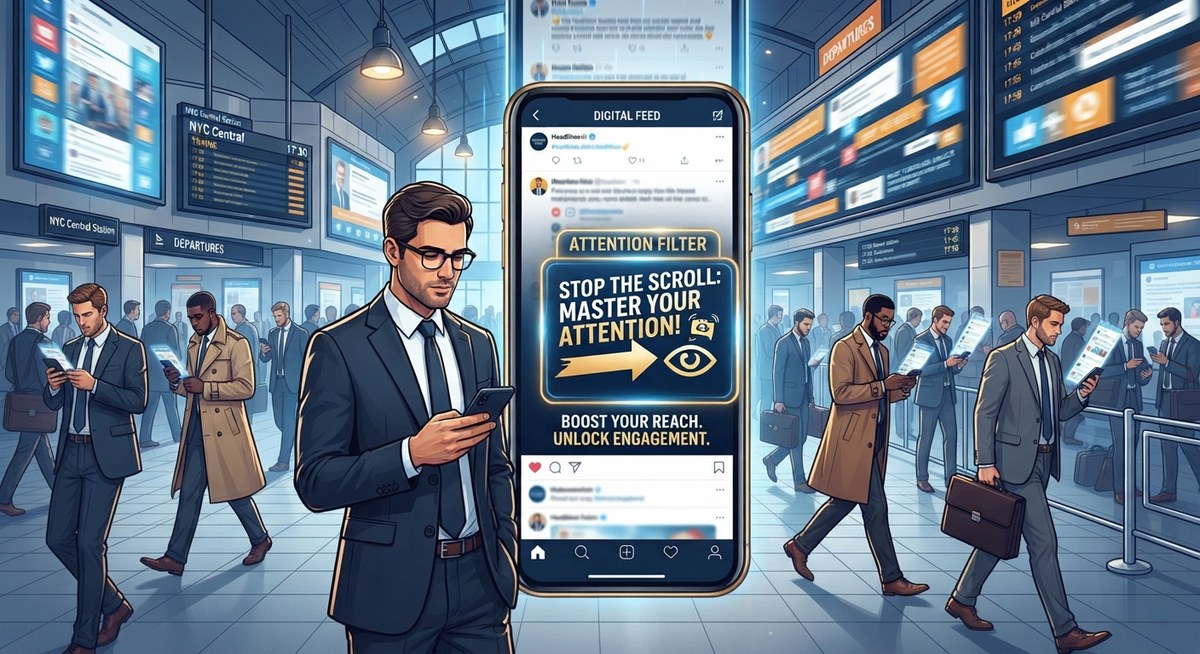
Imagine you are standing at a busy train station during rush hour. Thousands of commuters stream past the newsstands, eyes fixed straight ahead, scrolling mindlessly on their phones, surrounded by flashing billboards and ambient noise. A vendor holds up a book and shouts, "Hello, valued customer! Today I would like to present a comprehensive literary overview regarding historical socio-economic trends..."
Do you stop? Of course not. You don't even break your stride.
Now, imagine that same vendor steps forward, looks you dead in the eye, and says, "Everything you think you know about your retirement account is legally wrong."
Do you pause? Do you turn your head? Exactly.
In the digital landscape, your audience isn't strolling leisurely through an art gallery; they are rushing through that digital train station. Attention spans aren't just shrinking — they are practically extinct. Psychologists estimate that modern humans now possess an attention filter shorter than that of a goldfish, clocking in at roughly three seconds when scrolling through a feed.
Here is the brutal law of modern marketing: hook in 3 seconds. If your headline or intro doesn't grab them immediately, nothing else matters.
You can have the most brilliant product, the most profound insights, and the most beautifully designed website in the world, but if your opening hook fails, your brilliance dies in the dark. Let's explore why traditional introductions are killing your reach and how to master the art of the 3-second hook.
- Modern attention spans are roughly three seconds — if your opening doesn't deliver value or curiosity instantly, the reader is gone.
- Three psychological triggers stop the scroll: the pattern interrupt, the open loop, and the identity mirror.
- Invert the pyramid — lead with your boldest claim or statistic, not a slow chronological build-up.
- Write your hook last, once you already know the emotional peak of the piece you're introducing.
The Anatomy of the Scroll: Why Traditional Intros Fail
To understand why hooks matter so much, you have to look at consumer psychology on platforms like LinkedIn, Instagram, X (Twitter), or a blog homepage.
When someone scrolls through their feed, their thumb is primed for motion. Their brain is running a subconscious, ruthless filter asking one single question: "Why should I care about this right now?"
Most creators and businesses fail this test instantly because they start their content with warm-up throat-clearing. They write openings like:
- "In today's fast-paced digital world, it is becoming increasingly important to consider..."
- "Welcome back to my blog! Today I want to talk a little bit about..."
- "As a business owner for over ten years, I've learned a lot about..."
To the reader's brain, those sentences translate to a single word: boring. They signal that the writer is making the audience work just to find the point. And in a world overflowing with instant entertainment and bite-sized dopamine, nobody has the patience to work for their information. If you don't deliver an immediate jolt of value, curiosity, or emotional resonance in the first sentence, the thumb flicks downward, and you are gone forever.
The Three Psychological Triggers of an Irresistible Hook
Master copywriters and viral creators don't guess what makes a good hook; they rely on hard-wired psychological triggers. To stop the scroll, your opening line must pull one of three mental levers.
1. The Pattern Interrupt
The human brain runs on cognitive autopilot. We expect certain phrases, standard advice, and predictable formats. A pattern interrupt shatters that expectation instantly.
Standard intro: "Here are five tips for better email marketing."
Pattern interrupt: "Throw away your email marketing strategy."
2. The Open Loop (Curiosity Gap)
Our brains despise unresolved puzzles. When you state a shocking truth or hint at a hidden secret without immediately explaining it, you create an intellectual itch that the reader has to scratch by reading sentence number two.
"There is a silent mistake costing online stores 40% of their checkout revenue every single day. And most owners think it's normal."
3. The Identity Mirror
People care deeply about themselves, their struggles, and their identities. When your hook mirrors an exact frustration they experienced just an hour ago, they feel instantly seen.
"If you've spent the last three hours staring at a blank screen wondering why your ads aren't converting, stop reading and look at this."
The Shift: From "Chronological Order" to "The Value Drop"
In school, we were taught to write essays like a staircase: start with a broad introduction, build a background context, present your arguments in the middle, and save your best conclusion for the very end.
In modern marketing, that structure is professional suicide. You must invert the pyramid.
Put your most fascinating insight, your boldest claim, or your most dramatic statistic right at the very top. Give away your strongest punch in sentence one.
Think of your hook not as the front door to a building, but as a movie trailer. A trailer doesn't start with twenty minutes of the protagonist waking up and brushing their teeth; it drops you straight into the middle of the most explosive, high-stakes scene of the film to make sure you buy a ticket.
When you lead with the payoff, you earn the reader's trust — and their time — for everything that follows.
The Blueprint: Four Ways to Craft Hooks That Stop the Scroll
If you want to audit your current content and instantly lift your engagement, use these four proven hook frameworks.
Step 1: Kill the Preamble
Look at the first two sentences of your latest article, email, or social media post. Delete them entirely. Start reading from the third sentence. In 90% of cases, the third sentence is where your actual thought begins. Cut the throat-clearing.
Step 2: Use Bold, Unapologetic Contrarianism
Challenge a commonly accepted industry dogma. If everyone says you need to post every day to grow, start with: "Posting every day on social media is destroying your brand." (Just make sure you have the arguments to back it up!)
Step 3: Quantify the Pain or the Reward
Specific numbers cut through vague fluff. Instead of saying "Many businesses struggle with sales," say "92% of online stores lose customers on the checkout page because of one invisible design flaw." Numbers feel concrete, factual, and urgent.
Step 4: Write Your Hook Last
Never try to write your hook first when your mind is cold. Write your entire piece, article, or post first. Once you know what the core message and the emotional peak of your work actually are, go back to the top and craft a razor-sharp opening that points directly to that peak.
Conclusion: Capture Attention to Earn Trust
Mastering the 3-second hook isn't about clickbait, cheap manipulation, or shouting louder than everyone else. It is a profound act of respect for your reader's time.
It says: "I respect you too much to waste your afternoon. I know you're busy, I know your mind is crowded, and I promise you that what I have to say right now is worth pausing for."
Stop whispering in the middle of a train station. Drop the preamble, trigger their curiosity, and hook your reader before their thumb can betray you. Because if you don't capture their attention in the first three seconds, the rest of your brilliance might as well not even exist.
Frequently Asked Questions
Why do modern audiences have such short attention spans online?
Psychologists estimate the modern attention filter while scrolling is roughly three seconds — shorter than a goldfish's. If your opening line doesn't deliver an immediate jolt of value or curiosity, the reader's thumb moves on before they register anything else.
What are the three psychological triggers behind a good hook?
The pattern interrupt (breaking an expected phrase or format), the open loop (a curiosity gap the reader has to resolve), and the identity mirror (naming a frustration the reader just experienced so they feel instantly seen).
Why should I write my headline or hook last?
Writing the hook first, when your thinking is still cold, tends to produce generic openings. Write the full piece first, find its emotional or informational peak, then craft an opening line that points directly at that peak.
What is the 'Value Drop' structure?
Instead of building up gradually like a school essay, put your boldest claim, insight, or statistic in the very first sentence — the way a movie trailer opens on the most explosive scene rather than a slow morning routine.
Is hooking readers in 3 seconds the same as clickbait?
No. Clickbait promises something the content doesn't deliver. A genuine hook still delivers on its promise — it's simply respecting the reader's time by putting the most valuable or interesting part first instead of making them wait for it.