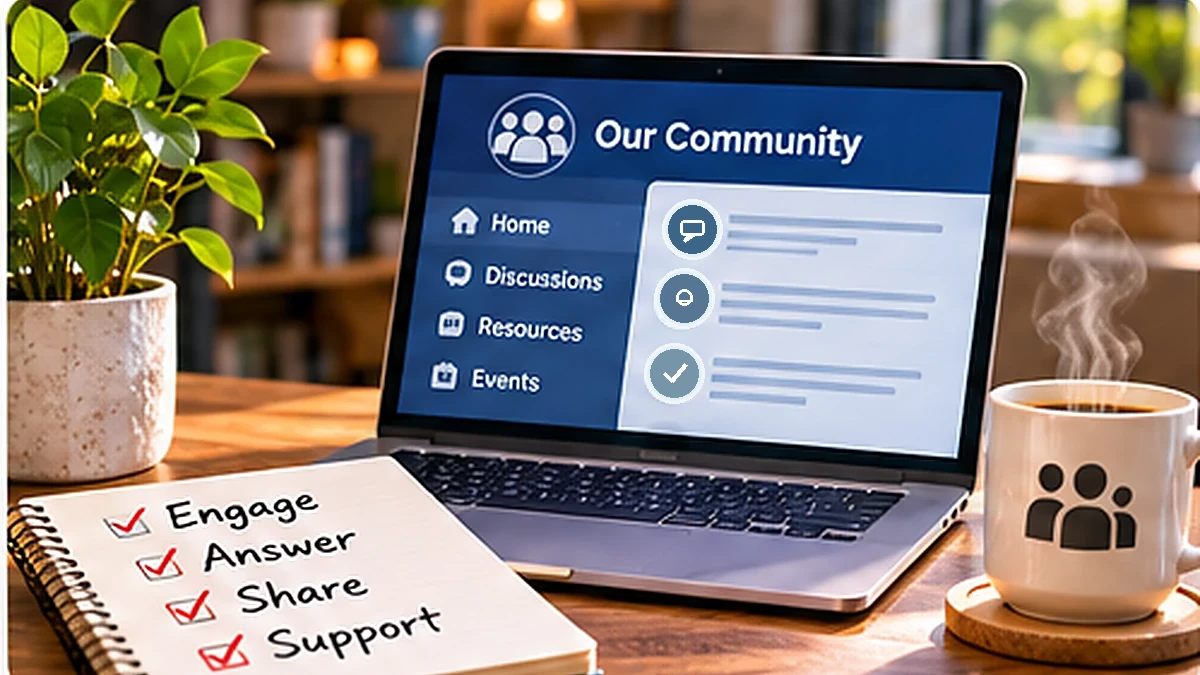
Build useful conversations that customers want to return to—not just another place to broadcast.
A crowd is not the same thing as a community
You can buy attention. You can boost a post. You can even attract a sudden wave of followers with a giveaway. But none of those numbers automatically mean that people care about your brand, know one another, or will return when the campaign ends.
A community is a different thing. It forms when people have a shared reason to participate and some space to contribute. The brand might host the conversation, but it is not the only voice in the room. Members answer one another, share useful experiences, offer ideas, and develop a sense of belonging.
That is why ten thoughtful conversations can tell you more about the strength of a brand than ten thousand passive likes. A healthy community can produce support, insight, and advocacy. The real question is not “How many followers did we gain?” but “What useful interaction happened because we brought these people together?”
A real case: customers help shape the product
LEGO’s official fan engagement program is a clear example of community doing more than applauding a company. Through LEGO Ideas, fans submit their own product concepts and support projects from other creators. LEGO says that ideas reaching 10,000 supporters can be considered for official review and potential production. The result is a participation loop, not just a marketing announcement.
Most small businesses cannot copy that scale, and they should not pretend they can. But the principle translates. A maker could invite regular customers to vote on future colors. A local fitness studio could ask members to propose workshop themes. A software team could maintain a thoughtful feature-request board and report what happened after feedback arrived.
Those examples are illustrations, not case studies with measured results. The real LEGO program shows the key mechanism: when members can meaningfully contribute, a brand becomes a place people help build.
Give people a reason to return without a discount
Discounts can attract attention, but a community needs a lasting purpose. Ask yourself what members gain by showing up when they are not currently buying anything. Do they learn a skill? Meet others like them? Get help solving a recurring problem? Find inspiration or accountability? If the answer is vague, your community will struggle.
A good starting point is a question so specific that your ideal customer wants to answer it. For a founder community: “What one process did you simplify this week?” For a photography brand: “Show the photo you almost deleted and why you kept it.” For a recipe brand: “What is the simplest dinner you cooked under pressure?”
These prompts are not elaborate campaigns. They are repeatable opportunities for useful participation. The point is to make being a member worthwhile, not to manufacture activity for an algorithm.
The four building blocks of real engagement
Before opening a new chat group or forum, design the experience people will have inside it. Structure makes participation easier, particularly for newcomers who may be unsure what to say.
1. One shared purpose
Write a sentence explaining who the space serves and the problem or interest members share.
2. One recurring ritual
Host a weekly question, monthly demo, or member spotlight people can expect.
3. Clear boundaries
Set practical rules against spam, harassment, misleading promotions, and privacy violations.
4. Visible listening
Show when feedback changed your content, product, or service—and when it did not.
The 2025 CMX Community Industry Report can be a useful starting point for understanding how community professionals think about value and measurement, even though the needs of a two-person business are different from those of a large brand.
Where should your people gather?
The answer depends on where your customers already feel comfortable. An email newsletter with replies enabled can be a small community. So can an intimate monthly online workshop. A private discussion group may work for a professional niche; an open forum can work for a hobby with lots of peer-to-peer questions.
Do not create three groups simply because three platforms exist. Start with one place and one consistent ritual. Moderation, member support, and useful replies take time. A silent group with 600 names looks less impressive than a helpful space of 60 active participants.
It is also wise to maintain an owned channel such as your website or email list. Social platforms can be useful homes for conversation, but algorithm changes and account restrictions are outside your control. Our article on bringing audiences back to owned media explains why that matters.
How to measure a conversation instead of a vanity number
Follower growth is easy to graph, but it can hide low participation. Choose a few measures that reflect the experience: the share of members who contribute, number of member-to-member replies, recurring attendance at events, questions answered, and product feedback you can actually use.
Review the qualitative side too. Are newcomers welcomed? Do members feel comfortable disagreeing? Are answers thoughtful or merely promotional? A community with honest, useful conversations is more resilient than one where every comment says “great post.”
The signal is not how many people can hear you. It is how many people have a reason to speak.
For an accompanying brand exercise, use the Brand Strategy Workbook and revisit our UGC guide to understand permission and attribution when featuring community contributions.
Mistakes that quietly make people leave
One mistake is turning the community into an endless sales funnel. Members notice when every discussion ends with the same pitch. Another is asking for feedback without acknowledging it. A third is posting so many prompts that meaningful conversations are buried under announcements.
Community is also not free labor. If you ask members to produce stories, moderation, product ideas, or testimonials, respect their contribution, seek permission before reusing personal content, and avoid presenting them as official endorsements without consent. When people feel exploited, they stop participating.
Finally, do not assume every business needs a large public community. Some customers simply want reliable service. A small member advisory circle, a thoughtful newsletter, or occasional customer roundtables may be a better fit than another app that nobody opens.
Design a conversation, not a content calendar
A content calendar tells the team what to publish. A community plan should explain what happens after people respond. Who welcomes someone new? Who answers a hard question? When an interesting idea appears, who follows up? If every post ends with a silent comment section, the experience is still a broadcast.
Try assigning simple roles. One person prepares the discussion topic; another watches for unanswered questions; a third records ideas worth bringing back to the product team. In a one-person business, these roles may all belong to the founder, so limit the scope until it is manageable. You are better off hosting one useful monthly conversation than announcing daily engagement that you cannot sustain.
One overlooked practice is closing the loop publicly. If members asked for a more accessible workshop time, say what you changed. If a product idea cannot be implemented, explain why without revealing confidential details. People do not need to win every debate to feel heard. They need evidence that thoughtful contributions matter.
Make it safe for newcomers to join
Every community has an invisible barrier: regular members already understand the tone, while newcomers wonder whether their question is too basic. Reduce that uncertainty with a short welcome note, a clear place to introduce yourself, and an example of what a useful contribution looks like. Do not expect new members to read a twenty-page rulebook before asking something simple.
Remember that private communities still involve privacy risks. Ask permission before quoting members in public marketing. Avoid publishing screenshots of personal messages without consent. Give people ways to report harassment or withdraw from a discussion. If the group includes customers sharing problems about work or family, make confidentiality expectations explicit.
The quality of the welcome matters because participation often starts small. One good answer from another member can change a hesitant visitor into a regular. A dismissive response can do the opposite. Community growth begins with how ordinary people are treated, not with the size of the launch announcement.
A 30-day community pilot
Rather than announcing a grand new community, invite a small group of relevant customers to one specific shared activity. Set expectations clearly and ask participants what would make future sessions worthwhile.
Week 1: listen
Interview five customers about what they wish they could discuss with peers.
Week 2: host
Run one small event or discussion around the strongest shared need.
Week 3: support
Answer questions promptly and encourage members to respond to one another.
Week 4: decide
Review participation, feedback, and your team’s capacity before expanding.
Community is not a shortcut to immediate sales. It is an investment in relationships and shared learning. If people return because the interaction is useful, the brand becomes more than a logo in a feed. It becomes part of how a group solves a problem together.
Frequently Asked Questions
What is the difference between an audience and a community?
An audience primarily receives content. A community has opportunities for members to participate, help one another, and shape shared experiences.
Do I need a private Facebook group?
Not necessarily. An email-based discussion, monthly workshop, or small member circle can be a better starting point.
How do I measure community engagement?
Look at meaningful contributions, repeat participation, member-to-member replies, feedback quality, and support value—not follower count alone.
Can a small brand build a community?
Yes. A focused group of a few dozen relevant participants can be more useful than a large passive following.