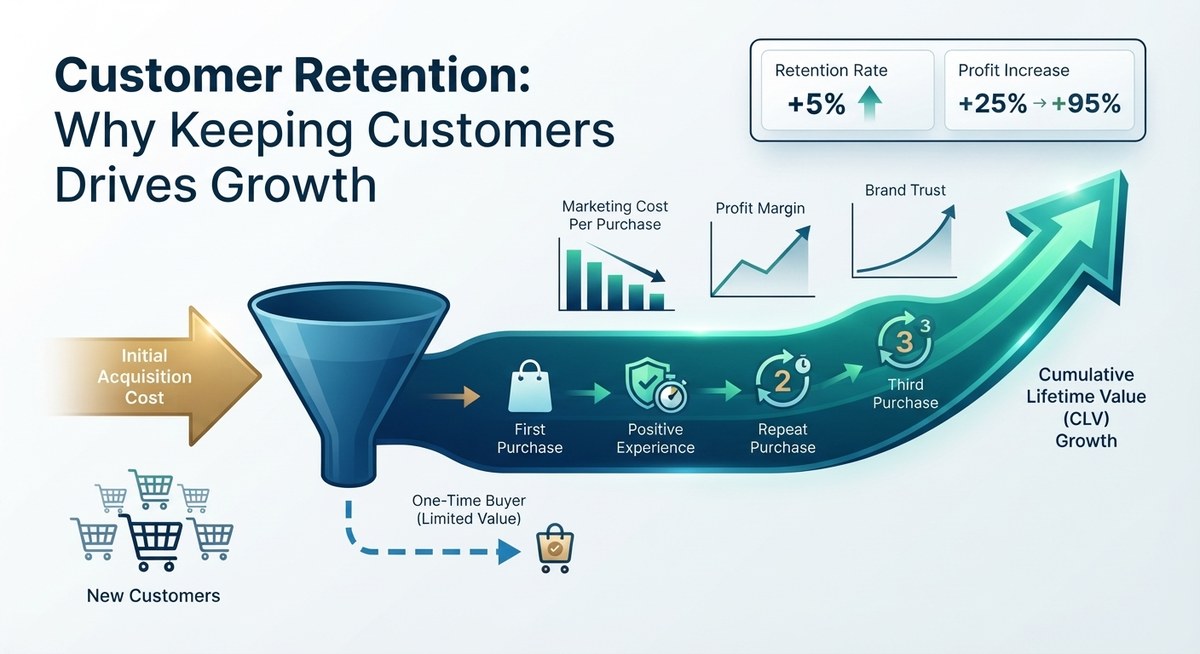
Sami ran a monthly meal-kit service. Every month, he spent more on ads and won about 100 new subscribers. Every month, he celebrated. And every month, his total number of customers barely moved.
It took him half a year to see why. For every 100 customers coming in through the front door, around 90 were leaving through the back. He was pouring water into a bucket full of holes.
That's churn: the rate at which customers stop buying from you. In our guide to customer retention, we explained why keeping customers drives growth. This article is about the detective work: how to find out exactly why customers leave, and what to fix first.
- Churn rate is the share of customers you lose over a period. Track it every month.
- Voluntary churn is when customers choose to leave. Involuntary churn happens when payments fail.
- A 2023 PYMNTS and FlexPay study of subscription businesses suggested failed payments may cause around half of churn.
- Exit surveys, conversations and usage data tell you why customers leave.
- Fix the biggest, most common reason first, not the loudest complaint.
The Leaky Bucket
Churn is dangerous because it's quiet. New sales are visible and exciting. Lost customers simply disappear. Many don't complain, they don't explain, they just stop.
But churn quietly decides your future. If you lose customers as fast as you win them, no amount of marketing will grow the business. And because winning new customers usually costs more than keeping existing ones, high churn also makes every new customer more expensive, as we explained in our guide to unit economics.
Before you spend more on filling the bucket, find the holes.
How to Measure Churn
The basic churn rate is simple to calculate:
Example: you start the month with 400 subscribers and 24 cancel. Churn = 24 ÷ 400 × 100 = 6% a month.
A 6% monthly churn might not sound like much, but it means losing roughly half your customers over a year unless you replace them. Small improvements here make a huge difference over time.
If you don't sell subscriptions, you can still track churn. Define an "active customer" as someone who bought in the last 3, 6 or 12 months, depending on how often people normally buy from you. Anyone who passes that window without buying has churned.
Two Kinds of Churn
Voluntary churn
The customer decides to leave. Maybe the product didn't meet expectations, the price felt too high, they found an alternative or they simply don't need it anymore.
Involuntary churn
The customer didn't decide anything. Their card expired, was replaced or was declined, and the payment failed. Many of these customers would happily have stayed.
Involuntary churn is often bigger than owners expect. A 2023 study by PYMNTS and FlexPay, based on a survey of subscription business executives, suggested that failed payments may account for about half of all churn. Even if your number is lower, it's the easiest kind of churn to fix.
How to Find Out Why Customers Leave
You can't fix what you don't understand. Here are four ways to hear the real reasons:
1. A short exit survey
When someone cancels, ask one multiple-choice question with an optional comment box. Keep it to one question so people actually answer.
2. Personal conversations
Email or call a few recent leavers and ask, kindly, what changed. Offer a small thank-you for their time. Ten honest conversations can reveal more than a hundred survey ticks.
3. Usage data
Look at what customers did before they left. Did they stop logging in? Skip deliveries? Never use a key feature? Behavior often reveals churn weeks before the cancellation.
4. Support tickets and reviews
Read complaints from the last three months. Repeated issues are early warning signs.
Too expensive / Not using it enough / Missing a feature I need / Quality or service issues / Found an alternative / Other (tell us more)
Make cancelling easy, even while you ask. Hiding the cancel button doesn't reduce churn. It just turns ex-customers into angry ones, and in some countries it can also break consumer rules.
Look for Patterns
Once you collect reasons, look for patterns, not individual stories. Ask questions like these:
- When do people leave? If many cancel after the first month, the problem is probably onboarding or first impressions.
- Who leaves? Customers from a certain ad campaign, discount code or region may churn more because they were never a good fit.
- What do stayers do differently? If customers who use a certain feature or buy a certain product stay much longer, guide every new customer toward it.
Grouping customers by the month they joined, sometimes called a cohort, shows whether your changes are working. If the customers who joined in March stay longer than those who joined in January, something you changed is helping.
Fixing the Biggest Leaks
Recover failed payments
Turn on automatic payment retries and card updates if your payment provider offers them, and send friendly reminder emails when a payment fails. This is often the quickest win.
Improve the first 30 days
Help customers get value fast with a welcome sequence, quick-start guide or personal check-in. Our guide to email automation shows how to set one up.
Offer a pause, not just cancel
Customers who are busy or traveling may prefer to pause for a month rather than leave for good.
Fix the top complaint
If "quality issues" or "missing feature" keeps coming up, that's your roadmap. Fix the most common reason before anything else.
Win back with care
After you fix a problem, tell past customers what changed. Some will come back, and they'll respect that you listened.
Conclusion: Plug the Holes First
Sami stopped increasing his ad budget for three months. Instead, he added a one-question exit survey, turned on payment retries and rebuilt his first-week experience. His churn fell, and the same 100 new customers a month finally started adding up.
This week, calculate your churn rate, add a one-question exit survey and check how many of last month's cancellations came from failed payments. Every customer who stays is a customer you don't need to win again.
Frequently Asked Questions
What is churn?
Churn is when customers stop buying from you or cancel their subscription. Churn rate is the percentage of customers lost over a period.
How do I calculate churn rate?
Divide the number of customers lost during a period by the number you had at the start, then multiply by 100.
What is involuntary churn?
Customers lost because a payment failed, for example due to an expired or declined card, rather than because they chose to leave.
How can I find out why customers leave?
Use a short exit survey, talk to recent leavers, study usage data before cancellation and review support tickets for repeated issues.
What is the quickest way to reduce churn?
For subscription businesses, recovering failed payments with automatic retries and reminder emails is often the fastest win.