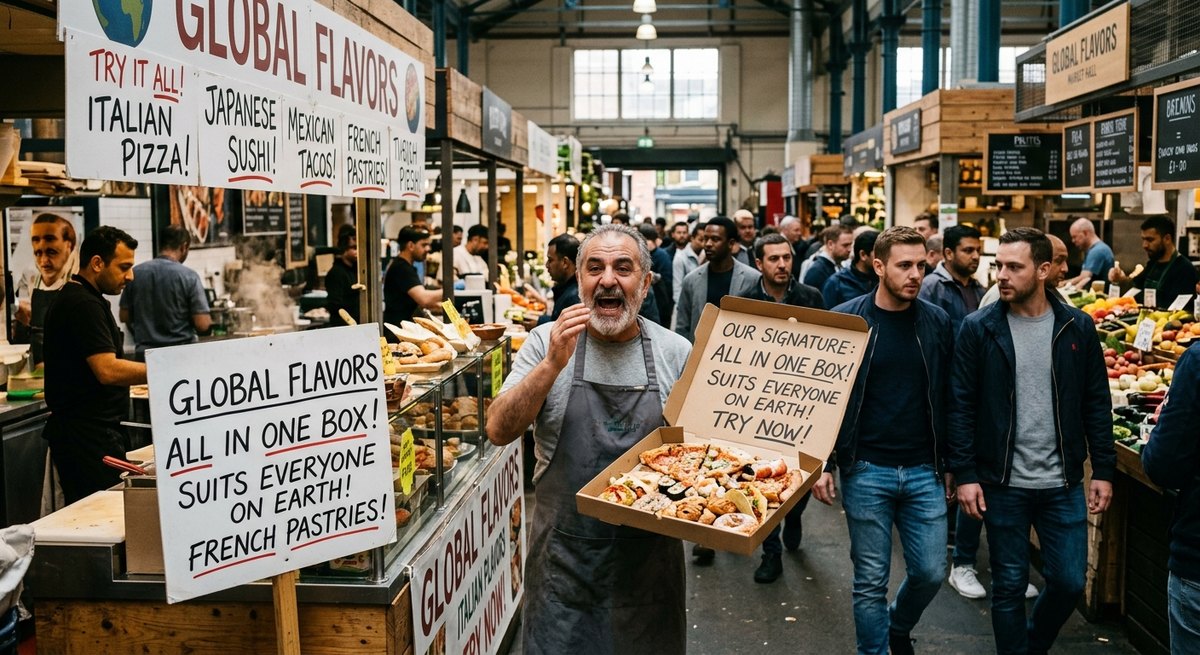
Emma opened a bakery with a menu that tried to please everyone: sourdough, cupcakes, wedding cakes, vegan options, gluten-free bread, coffee, sandwiches and weekly specials. She wanted every passerby to find something they liked.
Months later, she noticed an odd pattern. People said her bakery was "nice," but nobody told their friends about it. When someone needed a birthday cake, they went to the cake specialist. When they wanted bread, they drove to the sourdough bakery. Emma was a fine choice for everything, and the best choice for nothing.
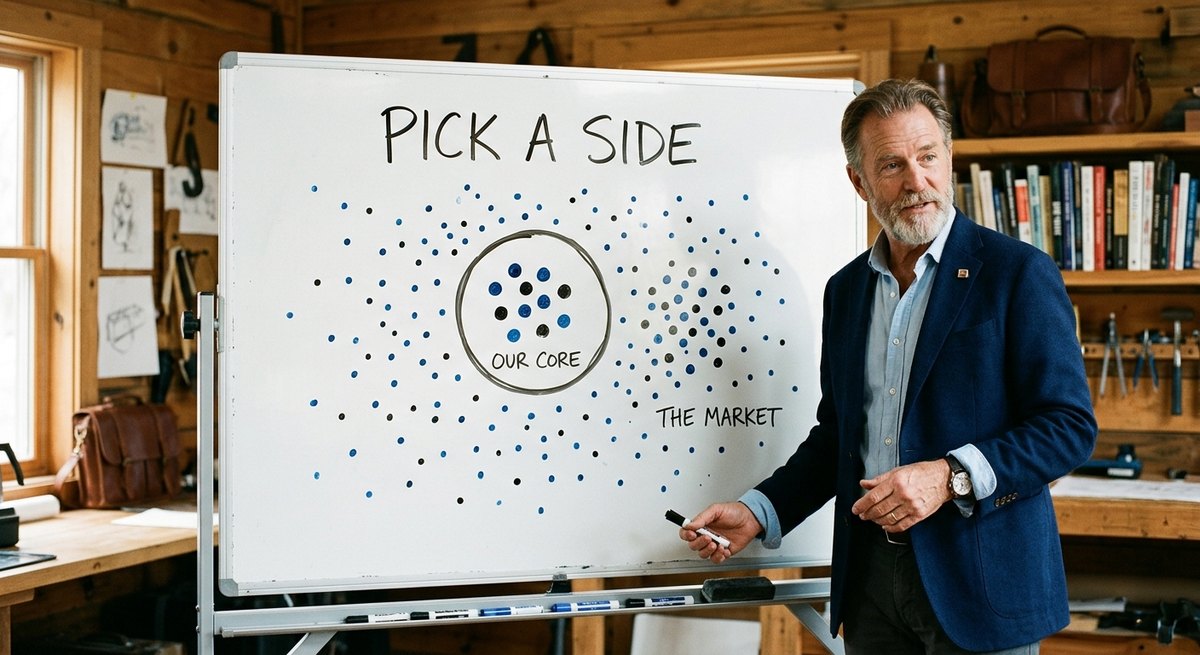
This is the problem of broad appeal. As we explained in why trying to be for everyone makes you for no one, being for everyone makes you forgettable. This article goes a step further: how to pick a side and become the obvious choice for a small, loyal group of people.
- Positioning is the place your brand holds in a customer's mind compared with the alternatives.
- Avis, a distant number two in car rental, grew by admitting it with the 1962 "We Try Harder" campaign.
- In 2011, Patagonia ran a Black Friday ad that said "Don't Buy This Jacket" to stand for its values.
- A strong opinion attracts the right people and repels the wrong ones, and that's the point.
- You don't need millions of customers. A small group of loyal fans can sustain a business.
The Danger of the Middle
Broad appeal feels safe. If you don't take a stand, nobody can disagree with you. But the middle of the market is crowded, and customers don't remember bland. When all your competitors say "quality, service, value," those words stop meaning anything.
Marketing writers Al Ries and Jack Trout made this point in their classic book on the subject, Positioning: The Battle for Your Mind, first published in 1981. Their argument is that the real fight happens in the customer's head, where there's room for only a few names in any category. Being clear and different matters more than being good at everything.
If you try to please everyone, you give nobody a reason to choose you.
The Number Two That Picked a Side
In the early 1960s, the car rental company Avis was a distant second to Hertz and was reportedly losing money. Instead of pretending to be the leader, its advertising agency, Doyle Dane Bernbach, built a campaign on the opposite idea: "We're only number two, so we try harder."
It was an unusual position. The ad turned a weakness into a promise of better service, and it gave customers an emotional reason to pick the underdog. Accounts of the campaign say that Avis moved from losses to a profit within about a year and gained market share in the years that followed, though sources differ on exact figures. What's clear is that picking a side gave the brand a personality.
Notice what Avis didn't do. It didn't claim to be the biggest, the cheapest or the best at everything. It chose one clear idea and built everything around it.
The Jacket Ad That Told You Not to Buy
On Black Friday 2011, the outdoor clothing brand Patagonia ran a full-page ad in The New York Times. It showed one of its best-selling fleece jackets under a headline: "Don't Buy This Jacket." The text explained the environmental cost of making it and asked shoppers to think before buying anything they didn't need.
It sounds like the opposite of marketing. But the ad made Patagonia's position impossible to miss: a brand that cares more about the planet than about a quick sale. According to PYMNTS, the attention the ad received helped lift the company's sales the following year.
A strong opinion works like a magnet. It pulls in people who share the belief, and it gently pushes away those who don't. And the people who join are often more loyal than a crowd attracted by a discount.
How to Choose Your Side
Positioning isn't a slogan. It's a series of choices. Work through these questions:
1. Who exactly is this for?
Describe a specific group, not "everyone who likes quality." For example: "first-time home bakers who want foolproof recipes" or "freelance designers who hate paperwork."
2. What do they struggle with?
Pick the most important problem for that group. Our guide on knowing your target audience can help you dig deeper.
3. What do you believe that others in your industry don't?
"Most diets fail because they're too strict." "Software shouldn't need a manual." A strong opinion gives you something to say.
4. What will you say no to?
Real positioning means leaving things out. Drop products, customers and messages that don't fit, as we describe in say no and focus on one big goal.
5. Can you prove it?
A position needs evidence: results, stories, guarantees and a product that matches what you say.
Write a Positioning Statement
Once you've answered those questions, write them in one sentence. A widely used template, popularized by Geoffrey Moore in his 1991 book Crossing the Chasm, goes like this:
Example: For first-time home bakers who are afraid of failing, Emma's Bakehouse is the baking school-in-a-box that guarantees a perfect loaf the first time, because every kit includes a video lesson and a pre-measured recipe.
You won't put this sentence on your website. It's a compass. It helps you decide what to post, what to sell and what to refuse. For a deeper look at the process, April Dunford's book Obviously Awesome offers a step-by-step method that many founders find practical.
When your position is clear, the rest of your brand should reflect it. Check your tagline, your website and your social profiles, as we explain in our brand audit guide and our article on tagline power.
But Won't I Lose Customers?
Yes, some. And that's fine. Trying to keep everyone usually means winning nobody's loyalty.
In a well-known 2008 essay, the writer Kevin Kelly argued that a creator needs only 1,000 true fans, people who will buy almost everything you make, to earn a living. His numbers depend on your price and product, but the principle holds: a small, devoted group is worth more than a large, indifferent crowd.
Also remember that a sharp position isn't a permanent cage. You can widen your audience later, once you've become the clear leader for your first group. Starting narrow is how most strong brands begin. The popular outdoor-cooler brand Yeti, for example, started by focusing on a demanding group of users, as we describe in our case study on Yeti.
Conclusion: Be Someone's First Choice
Emma stopped trying to please everyone. She closed the sandwich counter, dropped half the menu and became "the bakery for people who are learning to bake." She sold starter kits, ran weekend classes and posted her failures as well as her wins. Customers began recommending her without being asked.
This week, write your positioning statement and ask: who is this for, and who is it not for? Then remove one thing from your offer that doesn't fit. Pick a side. The right people will find you, and they'll stay.
Frequently Asked Questions
What is brand positioning?
It's the place your brand holds in customers' minds compared with the alternatives: who you're for, what you stand for and why you're the best choice for that group.
Why is broad appeal a problem?
Trying to please everyone makes a brand forgettable. The middle of the market is crowded, and customers rarely recommend something bland.
What was Avis's 'We Try Harder' campaign?
In the early 1960s, Avis, a distant number two to Hertz, ran an ad campaign built on being number two and trying harder. It turned its position into a promise of better service.
How do I write a positioning statement?
Use a template such as: For [specific customer] who [has this problem], [brand] is the [category] that [key benefit], because [proof].
Will a niche position limit my growth?
It can feel limiting, but strong brands often start narrow, become the clear leader for one group and widen their audience later.