

A few years back, two coffee shops opened on the same street.
Shop A spent months designing the "perfect" menu based on what the owners personally loved. Shop B just asked their first fifty customers one simple question: "What do you wish we had?"
Shop A quietly closed within a year. Shop B is still there, and it's packed every morning.
The difference wasn't luck, money, or fancy branding. Shop B listened. Shop A guessed. And that one habit — really listening — might be the single easiest growth hack available to any business, no matter how small.
- Real customer feedback beats internal assumptions because it reflects what people actually experience, not what you think they want.
- Four low-cost channels cover most of what you need: support messages, post-purchase surveys, social media, and short customer calls.
- Turning feedback into features works best as a repeatable 5-step loop: collect, find patterns, prioritize, close the loop, review monthly.
- The most damaging mistake is asking for feedback and then visibly ignoring it — that costs more trust than never asking at all.
Guessing vs. Listening: What's the Real Difference?
Here's the honest truth: most business owners think they know what customers want. But thinking and knowing are two very different things.
Assumptions come from inside your head. They're based on your own taste, what a competitor is doing, or what "feels right." They're often wrong, and they can be expensive.
Real feedback comes from your customers' actual experience. It's what they typed into a support message at 11pm. It's the thing they mentioned in a review. It's the question they keep asking over and over.
Think of it this way:
- Assumptions answer: "What do I think people want?"
- Feedback answers: "What do people actually want?"
Only one of those questions will reliably grow your business. As Harvard Business Review has pointed out, companies that stay closely tuned in to their customers consistently outperform those that don't.
Assumptions answer what you think people want. Feedback answers what people actually want.
Two Quick Stories: Big Companies That Listened Their Way to Success
You don't need to be a giant tech company to benefit from listening. But it helps to see how even the big names got there by paying close attention.
Slack almost wasn't a chat app at all. It actually started as an internal tool built by a small gaming company to help their own team talk while building a video game. The game didn't take off. But the team noticed something interesting — they personally loved using the chat tool they'd built for themselves, and so did the beta testers they shared it with. Instead of forcing the game idea forward, they listened to that reaction and rebuilt the whole business around the chat tool. That "side project" became Slack, one of the most popular workplace apps in the world.
Airbnb grew because they listened to complaints about bad photos. In its early days, Airbnb almost failed. Listings weren't getting booked, and the founders were confused. When they actually talked to hosts and guests, a simple pattern emerged: the listing photos were dark, blurry, and unappealing. So the founders grabbed a camera, personally visited hosts in New York City, and took better photos themselves. Bookings from those listings jumped noticeably. That small, listening-driven fix helped set the foundation for the company's later growth.
Neither of these companies succeeded because of a brilliant master plan. They succeeded because they paid attention to what was actually happening and adjusted. That's a lesson any business, at any size, can copy.
4 Simple Ways to Listen (No Big Budget Needed)
You don't need a research team or expensive software to start listening well. You just need to pay attention in a few key places.
1. Your support messages and emails
Every question or complaint is a tiny clue. If several people ask the same thing, that's not a coincidence — that's a signal.
2. A quick survey after someone buys or signs up
One simple question is enough: "What almost stopped you from buying today?" Ask it while the experience is still fresh in their mind.
3. Social media comments and reviews
People are often more honest on social media than anywhere else. Set a quick reminder to check your mentions and reviews weekly — you'll be surprised what you find.
4. Casual one-on-one chats
A 15-minute phone call with a handful of customers each month can teach you more than a hundred survey responses. Just ask, then listen — don't jump in with answers.
Copy-Paste Scripts You Can Use Today
Not sure exactly what to say? Here are simple, ready-to-use scripts for each channel above.
Feel free to tweak the wording to sound like you. The goal isn't perfect phrasing — it's simply opening the door for honest feedback.
From Feedback to Real Features: A 5-Step Process
Hearing feedback is only half the job. Here's how to actually turn it into something useful.
Step 1: Write it all down in one place.
Don't let good feedback get lost in random emails or sticky notes. Keep one simple list.
Step 2: Look for patterns.
Group similar comments together. One comment is a coincidence — five similar comments are a pattern worth acting on.
Step 3: Decide what matters most.
Ask two questions: How many people mentioned this? And how much would fixing it help? Focus there first.
Step 4: Tell people when you fix something.
A short "you asked, we listened!" message builds trust fast. It shows customers their voice actually matters.
Step 5: Make it a habit, not a one-time thing.
Set a monthly reminder to review feedback as a group. Listening only works if you keep doing it.
3 Mistakes to Avoid When Listening to Customers
Listening sounds simple, but there are a few common traps that can quietly waste your time and effort.
Mistake 1: Listening to the wrong audience
Not all feedback carries equal weight. A comment from someone who tried your product once and never came back matters less than a pattern from your most loyal, repeat customers. Pay closest attention to the people who actually stick around.
Mistake 2: Trying to build every single request
This is one of the biggest traps for small businesses. If you chase every suggestion, you'll end up with a messy, unfocused product that tries to please everyone and truly satisfies no one. Prioritize the requests that align with your core vision, not just the loudest ones.
Mistake 3: Asking for feedback and then doing nothing with it
This might be the most damaging mistake of all. If you ask customers what they think and then visibly ignore it, you actually lose trust — it would have been better not to ask at all. Only ask for feedback if you're genuinely ready to act on it.
Assumptions vs. Customer Feedback: A Quick Comparison
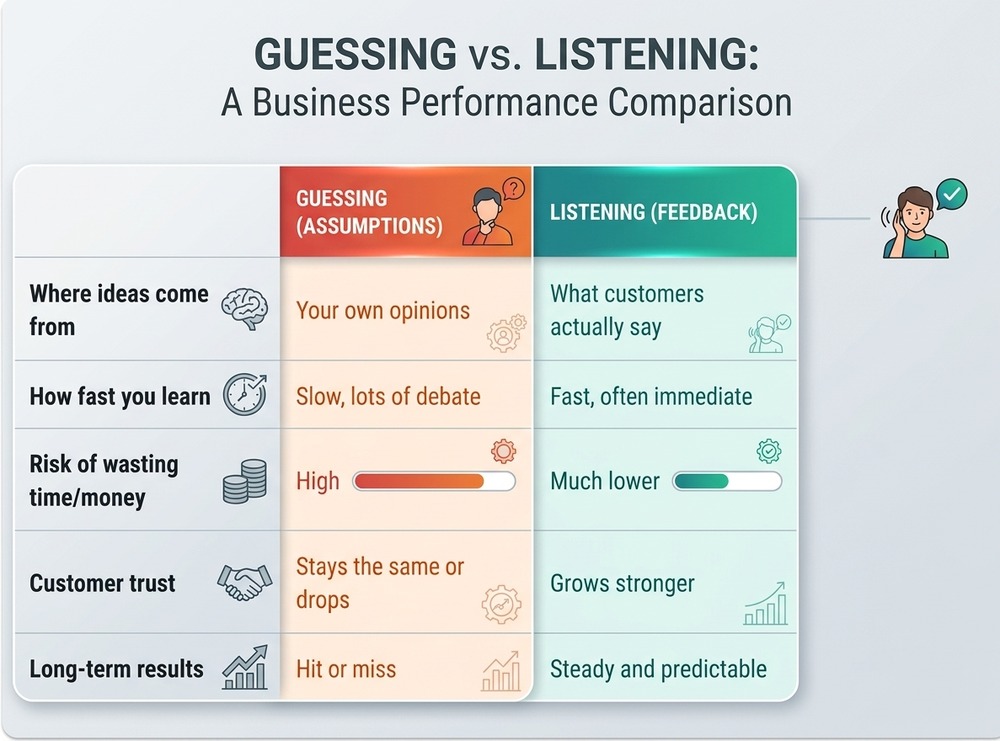
| Guessing (Assumptions) | Listening (Feedback) | |
|---|---|---|
| Where ideas come from | Your own opinions | What customers actually say |
| How fast you learn | Slow, lots of debate | Fast, often immediate |
| Risk of wasting time/money | High | Much lower |
| Customer trust | Stays the same or drops | Grows stronger |
| Long-term results | Hit or miss | Steady and predictable |
Start Small, Start Today
You don't need to overhaul your whole business to become more customer-centric. You just need to start listening — really listening — one small step at a time.
Pick just one thing from this article. Maybe it's reading through your last twenty support messages. Maybe it's sending one quick survey using one of the scripts above. Maybe it's calling three customers this week and simply asking how things are going.
Your customers already know what they need. All you have to do is ask, and then really hear the answer.
Frequently Asked Questions
Why is customer feedback more reliable than internal assumptions?
Assumptions come from inside your own head — your taste, a competitor's move, or a gut feeling. Feedback comes from a customer's actual lived experience with your product. Real feedback answers what people genuinely want, while assumptions only answer what you think they want.
What are the easiest ways to start listening to customers without a big budget?
Four channels cost little more than a bit of consistency: reading your support messages and emails for repeated questions, sending a one-question survey right after a purchase, checking social media comments and reviews weekly, and having casual 15-minute calls with a handful of customers each month.
What's the biggest mistake businesses make when asking for customers for feedback?
Asking for feedback and then visibly doing nothing with it. That single habit damages trust more than never asking at all — customers who feel ignored are less likely to bother giving feedback again.
How do you turn customer feedback into an actual product feature?
Follow a simple five-step loop: write every piece of feedback down in one place, look for repeated patterns, prioritize by how many people mentioned it and how much it would help, tell customers when you ship a fix, and review feedback on a regular monthly cadence so it becomes a habit rather than a one-off exercise.
How often should a business review customer feedback?
At least monthly. A fixed, recurring cadence turns scattered comments into a real pattern you can act on, instead of one-off complaints that get forgotten.