Businesses love new customers.
They are exciting. They make the sales dashboard look better, give marketing teams something to celebrate, and create the impression that the company is moving forward.
But there is a less glamorous question that can have a much bigger impact on the bottom line: what happens after the first sale?
A company can spend heavily on advertising, content, influencers, search, and sales teams to bring someone through the door. Yet if that customer buys once and never returns, the business has to start the expensive process all over again.
That is where customer retention becomes so important.
A widely cited estimate from Harvard Business Review puts the cost of acquiring a new customer at somewhere between five and 25 times the cost of retaining an existing one, depending on the industry and the study being considered. The exact number is not a universal rule, but the underlying business principle is difficult to ignore: replacing customers can be considerably more expensive than keeping the right ones.
And in a market where customer acquisition is becoming increasingly competitive, retention is no longer just a customer-service issue. It is a growth strategy.
- Acquiring a new customer can cost 5 to 25 times more than retaining an existing one, depending on the industry.
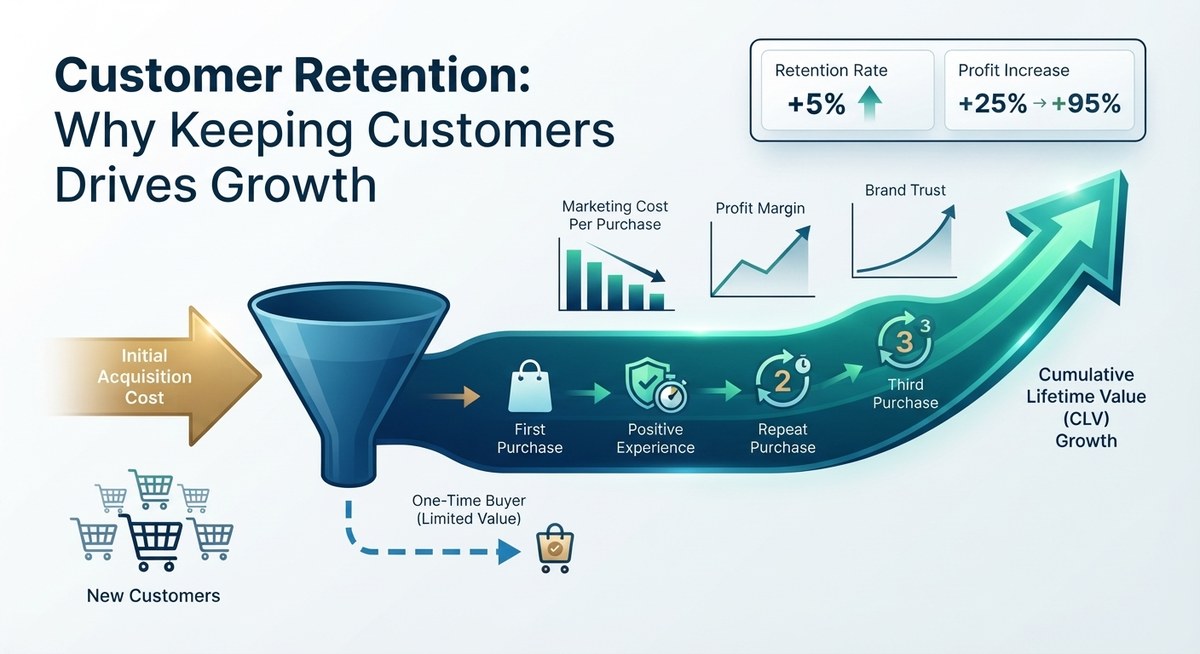
- A 5% increase in retention has been linked to profit increases of 25% to 95% in the businesses Bain studied.
- ButcherBox's story shows that as acquisition costs rise, retention becomes the more sustainable growth lever.
- Retention is behavior; loyalty is a relationship. Discounts can retain customers temporarily without building either.
The Real Cost of Losing a Customer
Imagine that an online brand spends $50 in marketing and sales costs to acquire a new customer.
That customer makes a $100 purchase.
At first glance, the company has made a sale and acquired a customer. The campaign appears to have worked.
But what happens next?
If the customer never returns, the company has to spend another $50 — or whatever its current acquisition cost happens to be — to find someone else who might make another $100 purchase.
Now imagine the original customer returns three more times. The company has already paid the cost of acquiring that customer. The next purchases do not require starting the relationship from zero.
That changes the economics.
The customer already knows the brand. They have used the product. They know how payment works. They have an expectation of delivery and customer service. Most importantly, some of the uncertainty that existed before the first purchase has disappeared.
The second sale is therefore not simply another transaction. It is evidence that the original investment in acquiring the customer is beginning to pay off.
This is one reason customer retention has such a direct connection to customer lifetime value, or CLV — the total value a customer can generate over the entire relationship with a business.
Retention Can Change the Economics of Growth
There is a common assumption that growth means finding more people. More leads. More traffic. More followers. More customers.
But sustainable growth is not only about how many people enter the business. It is also about how long they stay and how much value they create while they are there.
Research cited by Harvard Business Review from Frederick Reichheld of Bain & Company found that, in the businesses studied, a 5% increase in customer retention was associated with profit increases ranging from 25% to 95%.
That does not mean every company that improves retention by 5% will automatically increase profits by 95%. The economics vary considerably by industry, margins, customer behavior, and business model.
The more useful takeaway is this: small improvements in retention can have an outsized financial impact.
Why? Because retaining a customer can affect several parts of the business at once. The company may generate another purchase. Marketing costs per purchase can fall. Customer knowledge can improve. Opportunities for cross-selling and upselling can increase. And a satisfied customer may eventually recommend the brand to someone else.
One customer can therefore create value far beyond the first transaction.
ButcherBox Shows What Happens When Acquisition Gets Expensive
A recent example comes from ButcherBox, the U.S.-based subscription company that delivers meat and seafood to customers.
The company is particularly interesting because its growth story shows both sides of the equation: acquiring customers and keeping them.
Harvard Business Review reported in 2026 that ButcherBox surpassed $600 million in sales within roughly eight years of launching. Its early growth relied heavily on paid influencers. Over time, however, the company became more dependent on digital advertising as a way to acquire new customers.
Then the economics began to change.
According to the Harvard Business Review account, customer acquisition costs increased as paid influencers, social platforms, and search engines became more expensive. At the same time, customers acquired through those paid channels were becoming less attractive: they made smaller purchases and had higher defection rates.
That creates a problem familiar to many modern businesses. If acquiring the next customer becomes increasingly expensive while the quality of those customers declines, simply spending more on acquisition is not necessarily a sustainable growth strategy.
Retention becomes more valuable.
ButcherBox's story is a useful reminder that growth has to be measured by the quality of customers a business acquires, not just the number of customers it adds. A thousand new customers who disappear quickly may be less valuable than a smaller group that continues buying for years.
The Second Purchase Is a Critical Moment
For many businesses, the first purchase gets all the attention. The customer sees an advertisement. They click. They browse. They compare options. They finally buy. Marketing celebrates the conversion.
But from a retention perspective, another moment may be even more important: will they buy again?
The first transaction tells you that the customer was interested enough to take a chance. The second transaction tells you that the experience was good enough — or the value was strong enough — to make them return.
This is especially important for ecommerce businesses. A customer who buys a pair of running shoes once may simply have needed shoes. A customer who comes back months later for another pair, then buys socks and accessories, is behaving differently.
The business is no longer dealing with a one-time transaction. It is developing a relationship. That relationship can become increasingly valuable as trust grows.
Retention Is Not the Same as Loyalty
There is an important distinction here. Retention is behavior. Loyalty is a relationship.
A customer might continue buying from a company because switching is inconvenient. Another customer might genuinely prefer the brand and recommend it to friends. Both customers are technically being retained, but the strength of the relationship is different.
This matters because businesses can sometimes create short-term retention through aggressive discounts. Offer 30% off and some customers will stay. Offer another discount three months later and some may stay again. But if the business stops offering discounts, those customers may disappear.
That is not necessarily loyalty. It may simply be price sensitivity.
Strong retention usually comes from something more durable: a product that consistently delivers, reliable service, convenience, personalization, trust, or a customer experience that makes returning feel like the obvious choice.
As Harvard Business Review has noted, customers are more likely to stay when the company continues to deliver meaningful value for the job the customer needs it to do.
The best retention strategy, in other words, is often not a better coupon. It is a better reason to stay.
Great customer service is part of this too. A business may spend thousands of dollars attracting customers, only to lose them because of a problem that costs $5 to fix — customers do not experience a company in departments. They experience one company.
The Blueprint: Seven Ways to Improve Customer Retention
The good news is that improving retention does not always require a complicated loyalty platform or a huge marketing budget. Start with the basics.
Step 1: Make the First Purchase Easy
Clear pricing, simple checkout, accurate product information, and reliable delivery remove unnecessary friction.
Step 2: Improve the Experience After the Sale
Useful onboarding, follow-up messages, product education, and accessible support help customers get more value from what they bought.
Step 3: Make the Second Purchase Easier
Remembering preferences, simplifying reordering, offering relevant recommendations, or reminding customers when they may need the product again can reduce friction.
Step 4: Study Churn Instead of Simply Reporting It
A churn rate tells you what happened. Customer interviews, support tickets, behavioral data, and cancellation reasons can help explain why.
Step 5: Give Customers a Reason to Return
That could be excellent service, convenience, new products, useful content, personalization, or simply a consistently good product.
Step 6: Segment Your Customers
A new customer, a frequent buyer, a high-value customer, and a customer who has not purchased in a year may require very different strategies.
Step 7: Measure Lifetime Value, Not Just Monthly Sales
A customer who spends $100 today is not necessarily more valuable than one who spends $50 today and keeps purchasing for five years.
The Bottom Line
Customer retention is sometimes treated as a secondary marketing tactic — a loyalty program here, an email campaign there. It deserves more attention than that.
Retention affects the economics of growth. When a business successfully keeps customers, it gets more opportunities to recover the cost of acquiring them, generate repeat revenue, deepen the relationship, and potentially benefit from referrals.
The famous "five times cheaper" figure is best understood as a useful rule of thumb rather than a universal law. The actual economics vary by industry, customer type, margins, and business model. Harvard Business Review itself cites a broader range of five to 25 times when discussing acquisition versus retention costs.
The more important lesson is simpler. You should not have to win the same customer over again from scratch every few months.
Acquisition gets the relationship started. Retention determines what that relationship becomes. And for businesses trying to grow without endlessly increasing their marketing spend, that distinction can make all the difference.
Frequently Asked Questions
How much more expensive is it to acquire a new customer than to keep one?
Estimates cited by Harvard Business Review put it at roughly five to 25 times more expensive, depending on the industry and study. The exact multiple varies, but replacing customers is consistently costlier than retaining the right ones.
What is customer lifetime value (CLV)?
It's the total value a customer generates over their entire relationship with a business, not just their first purchase. A customer who returns repeatedly can be far more valuable than their first transaction suggests.
What happened to ButcherBox's acquisition costs over time?
As paid influencers, social platforms, and search ads became more expensive, ButcherBox's newly acquired customers also became less attractive — smaller purchases and higher defection rates — making retention comparatively more valuable.
Is retention the same thing as customer loyalty?
No. Retention is behavior — a customer keeps buying. Loyalty is a relationship — the customer genuinely prefers the brand. A discount can retain a price-sensitive customer temporarily without creating real loyalty.
Why don't discounts fix every retention problem?
If customers are leaving due to poor product quality, unreliable delivery, or hard-to-reach support, a discount only makes it cheaper to repeat a bad experience. The underlying reason for leaving has to be diagnosed first.
What's a simple way to start improving retention?
Begin with the basics: make the first purchase frictionless, improve the post-sale experience, and study why customers actually churn instead of only tracking the churn rate as a number.